
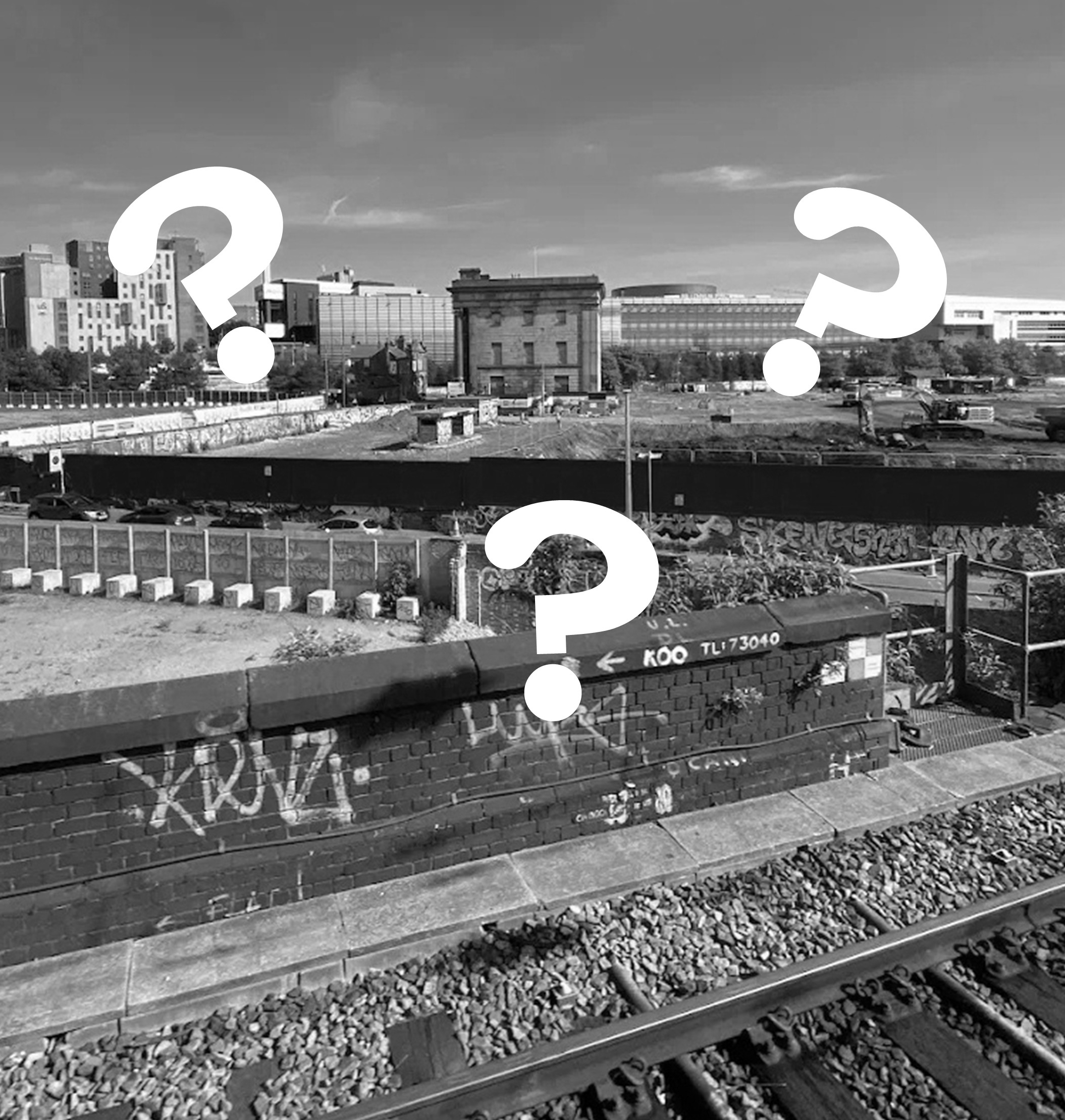
The urban landscape is constantly changing. Sometimes for the better, sometimes for the worst. In years gone by, innumerable buildings, and even entire streets, have been demolished in the name of development. Yet, what about those which have survived the wrecking ball but have become lost in a familiar skyline? In this month’s blog, I discuss a mystery in plain sight which I recently solved.
Living in Milton Keynes and being without a car, I often take the train to visit friends and family in the north of England. This usually involves a change at Birmingham New Street; a relatively easy change provided the trains are running. It recently took me 8 hours and 4 changes to travel from Milton Keynes to Darlington after a power outage at Cross Country’s control centre in Birmingham obliged them to cancel all services (it usually takes me between 4 – 5 hours and 1 change). On the inbound journey to Birmingham New Street from Milton Keynes, though, I was reminded of a mystery which has teased my mind every time I’ve taken this journey and that is: what IS that building?
Made of stone with nineteenth century style architecture, the building stands alone, first in the midst of wasteland and now a building site. Its windows are boarded up and there are no obvious indications of its original purpose. Due to the distance between the railway line and the building (see photograph above), it’s easy to overlook the structure. Yet its original purpose has always been a source of intrigue to my writer’s mind.
I did a brief internet search after I saw the building for the first time. Whether I’d not entered the right search terms, or there simply wasn’t enough information about the building out there, I was unsuccessful in answering this burning question. As I was travelling to meet friends, I forgot about the mysterious building until the next time I was travelling by train into Birmingham New Street. Again, the question of what IS that building? reared its head.
My initial thoughts were it could’ve been a bank or some form of exchange. I assumed it was protected since it still stood when everything else around it had been demolished. My curiosity demanded I somehow make my way to the building and find a way in to explore it (which I didn’t act upon). I also wondered what was being built around it and how this mysterious building would be incorporated into it.
Finally, yesterday, I managed to do a successful internet search after seeing this building on yet another inbound journey into Birmingham New Street station. Built in 1838, it was the main entrance building to the Birmingham railway station, the main passenger terminus jointly built and operated by the London and Birmingham Railway (L&BR) and the Grand Junction Railway (GJR) companies. In 1852 it was renamed to Curzon Street, in 1893 it was closed to passengers, and, in 1966, it was closed to goods trains.
I was delighted to also discover that the old entrance building has been incorporated into the designs for the new HS2 Birmingham Curzon Street station, meaning it will be preserved for generations to come. Therefore, I can continue to look upon this magnificent structure each time I travel into Birmingham New Street – and know what it is!
Which mysterious structures have you noticed whilst travelling by train?
Let me know in the comments below.
~ T.G. Campbell, September 2026
Leave a Reply