
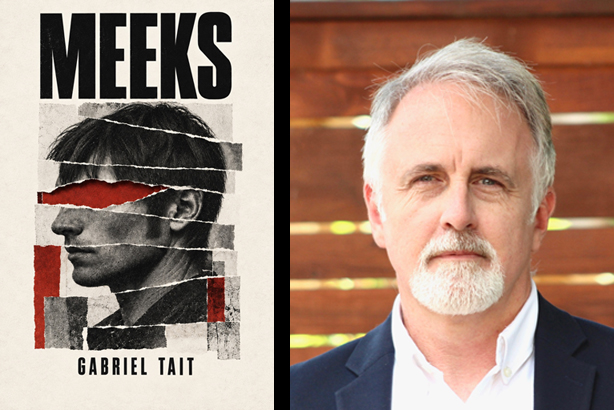
Dr Percy Weeks, a Canadian surgeon with a chronic alcohol addiction, has been a Bow Street Society regular since the first book. If you’ve followed the In Conversation with… web series on YouTube, you might’ve also seen the interview with Canadian actor Evan Sabba. Needless to say, then, that Canada is a recurring theme within my content, and a country I’d love to visit someday. Therefore, I’m absolutely delighted to be welcoming Gabriel Tait to this month’s blog to discuss his writing, how he drew upon his own experiences with addiction to create a multi-layered and absorbing main character, and more.
Please tell us a bit about yourself.
I’m Gabriel Tait, a Toronto-based independent author. I took a swing at writing fiction at fifty, which was a total left turn, surprising family and friends and probably most of all me.
I’ve written Meeks and a second book in the series, The Ranleigh Tapes. Both follow Ranleigh Meeks, a man who can be funny, frustrating and very good at making his own life difficult. My own experience in recovery from alcoholism informs the books. I’ve been sober since 2001.
I’m now working on Echo, the third and final book in the series, slated for release in late 2027.
You began writing fiction at age fifty after sitting on an idea for decades. What was it that persuaded you to finally pursue that idea and take that next step?
I was turning fifty and wanted to do something completely different, something I’d never attempted before. I’d had the idea for Meeks since my early twenties, and my family encouraged me to finally do something with it. Rereading Stephen King’s On Writing helped get me moving. I decided the most surprising thing I could do at fifty was actually write a novel. I don’t subscribe to midlife crises, but I was ready for a different challenge. I think it turned out pretty well.
Please tell us a bit about your books Meeks and The Ranleigh Tapes.
Meeks follows Ranleigh Meeks from the Canadian Prairies to Toronto, through addiction, strained relationships and decisions that tend to make a bad situation worse. He wants a different life, but he has a talent for getting in his own way.
The Ranleigh Tapes picks up six months into his sobriety. This time, Ranleigh gets to tell his side of the story, sitting across from a sponsor with a tape recorder running. It’s a novella written as a recorded conversation, so you’re hearing his version of events, with everything that implies.
As a Canadian writer, do you think the world views Canadians through the lens of a particular stereotype? If so, how do your books Meeks and The Ranleigh Tapes challenge this view?
I think in some parts of the world there’s still a maple syrup view of Canada, although that’s starting to change. The stereotype of polite, agreeable Canadians doesn’t have much relevance to my books. I wasn’t setting out to challenge it. I was focused on the characters and the story.
The Canadian landscape does play a big part. It’s almost like another character in the novels, and I think the books have a distinctly Canadian flavour. For someone who isn’t from here or has never visited, they offer a solid representation of Toronto without being a travelogue.
Your books are focused on the main character’s experiences, decisions, and descent into addiction. What was your process for creating that troubling central character and how did your own experiences with addiction inform that process?
My experience in recovery from alcoholism informed both books a great deal. Beyond my own experience, I’ve heard thousands of stories from people struggling with remarkably similar things. That gave me plenty to draw on when writing Ranleigh without telling anybody’s story specifically.
I wanted him to be a person readers could recognize, even if they’d never experienced addiction. Most people know what it’s like to feel ashamed, want a different life or tell themselves something they know isn’t quite true. Ranleigh takes those things much further.
He can be selfish, funny, frustrating and difficult to like. You can understand him and still think he’s behaving terribly. That mattered to me. I wanted to give readers someone worth following, even when he’s going somewhere they’d have the sense to avoid.
There is crime and violence in your books, which inevitably bring with them the question of whether their inclusion progresses the plot or delivers a sensational gut-punch to the reader. How did you navigate this aspect of your books and what practical advice would you give another writer who’s tackling the same question in their own work?
I’m a big believer that consequences teach. When someone in the throes of alcoholism or addiction hits a bottom, it’s often not a pretty thing. If Ranleigh’s bottom had simply been getting fired or spending too much money, I don’t think it would have carried the same impact within his story.
The violence came out of Ranleigh’s story. I’m not a fan of violence for its own sake. I think too many writers lean on it for shock value. I wanted his recovery arc to feel as authentic as possible, and I’m comfortable with the decisions I made for the book.
My advice to other writers would be that if the violence makes sense within the story, moves it forward and has a reason to be there, then include it. If you’re doing it purely to shock people or sell books, I’m not a fan.
I’d like to thank Gabriel for taking the time to chat with me today, and I hope you found it as fascinating as I did. Meeks is definitely going on my TBR list!
~ T.G. Campbell, November 2026
Leave a Reply