
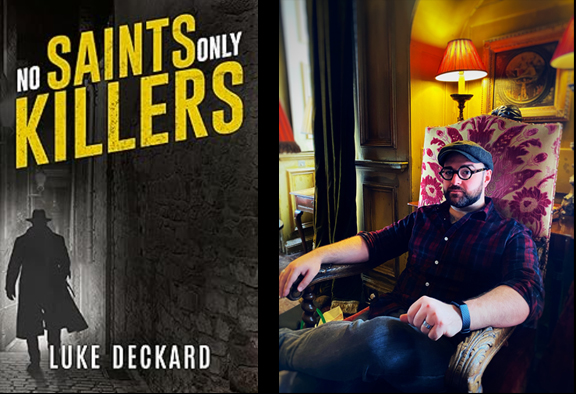
I’m always fascinated by my fellow crime authors’ approach to their work and my guest in this month’s blog is no exception. Dr. Luke Deckard is both a good friend and one of my “shut-up-and-take-my-money” authors. Therefore, I’m delighted to be welcoming him to the blog to discuss the importance of reading, research, and more.
Please tell us a bit about yourself.
I’ve never been good at this stuff, ha! According to my website: I live, write, and podcast in London, UK. I have a Master’s and PhD in Creative Writing from Kingston University and mentor creative writing students at the University of Westminster. My PhD novel, No Saints Only Killers, was shortlisted for multiple awards, including the Amazon New Voices Award in 2022 and Bloody Scotland’s Pitch Perfect in 2021 (under the title Wasteland). In addition to writing novels, I’ve published dozens of short stories, co-edited short story collections—including the Amazon bestseller Virtual Noir at the Bar—and written numerous scripts for award-winning docu-drama podcasts.
No Saints Only Killers was influenced by film noir. You also co-host the Mean Streets podcast, which discusses this cinematic genre. What is your favorite film noir movie and why? Also, what is it about this genre that interests you?
Well, No Saints wasn’t really influenced by film noir, though I understand why many people think that. I wanted to write something in the classic American hard-boiled genre. My influences were hard-boiled writers of the late 1920s, ’30s, and ’40s, like Dashiell Hammett, Raymond Chandler, and Carroll John Daly. But also Hemingway, T.S. Eliot, a lot of WWI poetry, and George Orwell.
I originally wrote No Saints Only Killers—titled Wasteland at the time—for my PhD, which I completed in 2023. I wrote a classic hard-boiled novel to explore and play with the quintessential American PI by placing him in a foreign land, much like Hemingway does with his characters. I also wanted to peel back the layers of PTSD and examine how classic hard-boiled detectives like Philip Marlowe, Sam Spade, and Race Williams might operate if they were dealing with ‘shell shock’—something most classic hard-boiled novels tend not to do.
The hard-boiled genre, since its inception in the early 1920s, has remained one of the most versatile forms. It took over literature, then stormed Hollywood in the ’40s, and continues to thrive today. It’s an endless well—which is why we see it influencing contemporary novelists like Robert B. Parker, Sue Grafton, Ian Rankin, Lee Child, Mike Phillips, and Sara Paretsky, as well as historical crime writers like Philip Kerr, Walter Mosley, and Chris Lloyd. Its appeal lies in its ability to thrill and entertain while also serving as sociopolitical (and historical) commentary. As Chandler wrote in his famous essay The Simple Art of Murder, the hard-boiled form strips away the overly intricate plotting of British Golden Age mysteries (and modern cozy crime) and instead roots itself in reality, giving murder “back to the kind of people that commit it for reasons, not just to provide a corpse.”
As for my favourite film noir… that changes daily. But two films that span the classic era through neo-noir would be Out of the Past and Chinatown. They’re dark, gritty, and brutal. They capture what makes hard-boiled fiction so enticing—femme fatales, flawed heroes, and a world of injustice.
No Saints Only Killers is set after the First World War, and there is a fantastic sense of time and place within the book. How much research did you do into the book’s era and settings, and how important do you think it is to get these details accurate?
I did an incredible amount of research. I read stacks of books and articles about the 1920s and earlier to ensure I nailed an authentic sense of time and place. I visited Edinburgh many times to get a feel for the city. I don’t think historical accuracy is everything in historical fiction—it’s fiction, after all. Of course, you have to play fair with technology and science; you can’t stretch those too far. But you might invent a street, a building, a club, or a hotel. What matters is being fair with the reader by depicting authentic experiences and attitudes of the time.
Some historical details simply can’t be ignored. For No Saints Only Killers, that meant recreating 1920s Edinburgh—its social attitudes, politics, and the wider sociopolitical issues of Britain at the time. I spent a lot of time researching crime and corruption, which led me to the coal miners’ struggles, fears of communism, and the poor treatment of Lithuanians. Those elements had to feel authentic for the plot to work and for the characters to feel real.
They say all writers include a little of themselves in their characters. Which of your characters do you think you put the most of yourself into, and why?
Yes, I think we all put a little of ourselves into our characters—sometimes even a little of who we’d like to be. In No Saints Only Killers, there are shades of me in Logan Bishop. We’re both Americans in Britain, disillusioned with the state of our home country, just trying to make do in a foreign land that sometimes accepts us and sometimes does not.
What advice would you give to someone who is thinking of writing their first crime fiction novel?
Read, read, read, read, read. I mentor creative writing students at the University of Westminster and have taught various classes on the subject. A common theme I come across—particularly with young writers (not always in age, but in experience)—is that they are not reading. If you want to be a writer, you need to read!
I’d like to thank Dr Luke Deckard for taking the time to chat with me today. I’m sure you’ve enjoyed reading about his perspective on writing, etc as much as I have. I thoroughly enjoyed No Saints Only Killers and I sincerely hope there will be another outing for the American PI who is a long way from home.
~ T.G. Campbell, June 2026